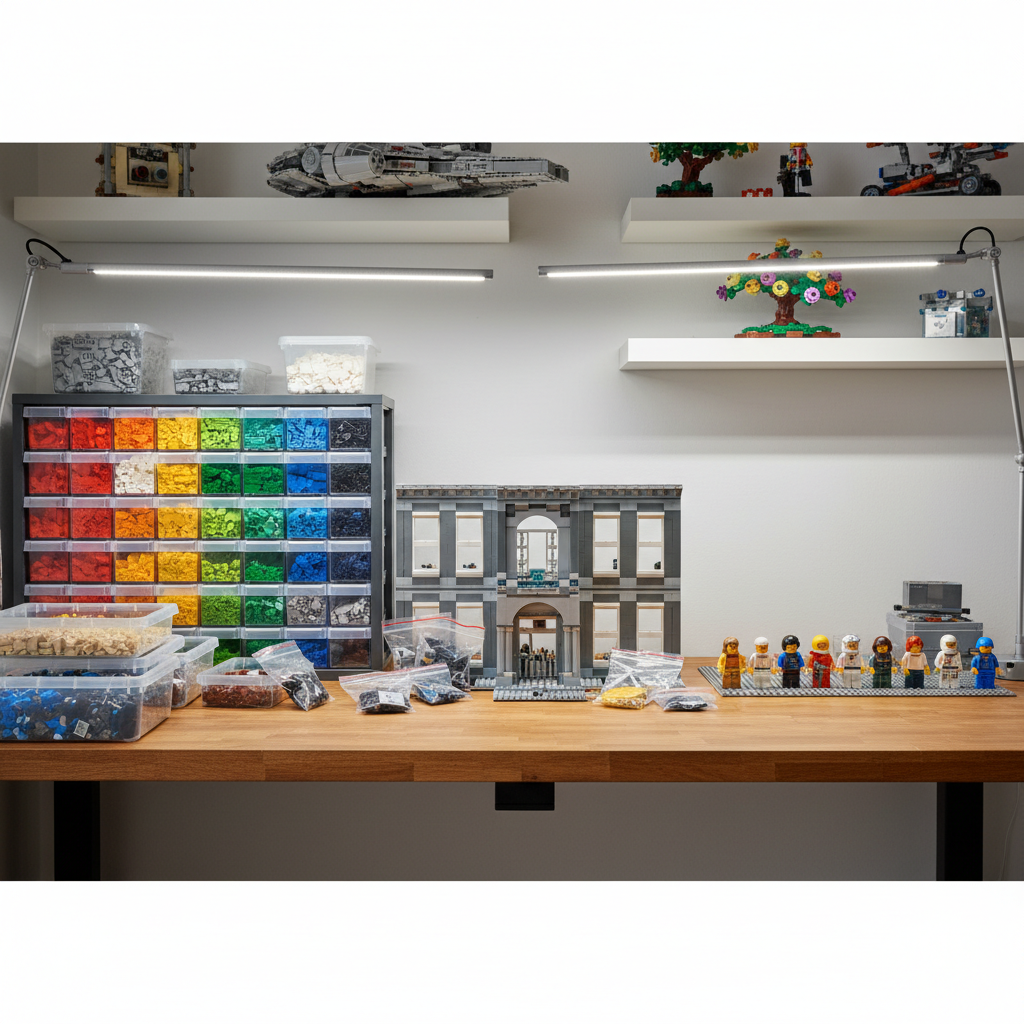
A LEGO building area works when four things are right: a big enough surface that stops pieces escaping, light that does not leave your hands in shadow, the parts you need within reach, and a chair that keeps you comfortable for a long build. None of it needs a dedicated room.
Quick answer: a large table plus a rimmed tray or mat, a daylight-coloured desk lamp alongside room light, shallow drawers within arm's reach, an upright chair, and covered display for finished models.
The surface
Build on the largest flat table you can spare, and give it an edge: a tray or a building mat with a raised rim keeps parts from rolling off and lets you lift a half-finished build out of the way. A light, plain surface makes small dark parts easier to spot. Something like a large sorting tray with a raised edge does both jobs.
The light
Overhead room light alone leaves your hands and the instructions in shadow. Add an adjustable desk lamp with a daylight-coloured bulb on the side of your building hand, so the light comes from more than one direction. A desk lamp with an adjustable arm lets you aim it at the build.
Storage within reach
Keep the parts you reach for most in shallow drawers or trays you can see into, within arm's reach of your seat, and the rest of the collection further away. Sort them the way you actually look for parts: by type for most builders, by colour if you build mosaics, or a mix of both. Our guide to sorting and organizing a LEGO collection compares the methods, and our free Sorting Planner splits the parts from a list of sets into the number of bins you have. A small drawer cabinet for small parts is the usual first purchase.
Seating and posture
Long builds are easier with the table at a height where your forearms rest on it and a chair that keeps you upright, rather than leaning over a low coffee table. Stand up and stretch between bags or sections, and keep the instructions propped up in front of you so you are not looking down all the time.
Finished models and dust
Dust is the main enemy of a display. Put finished models behind glass or acrylic, or on a covered shelf, and dust open displays with a soft brush. Our guide to protecting LEGO from dust covers cases and cleaning, and DIY LEGO display with IKEA furniture covers shelves and cabinets.
Small spaces
If the table has to be cleared every evening, a large tray for the build in progress and a set of stackable boxes for the parts let you pack up in minutes. Our guide to LEGO storage for small spaces has more ideas.
Related guides
This guide is research based.