
Article Summary

Master the art of LEGO organization with our comprehensive guide covering beginner to advanced sorting techniques, storage solutions, and workflow tips for builders of all levels.

Staring at a massive pile of unsorted LEGO bricks can be overwhelming. Whether you've just purchased a bulk lot, inherited a collection, or your builds have outgrown their storage, proper organization transforms chaos into creative potential. This comprehensive guide covers proven sorting methods from beginner to advanced levels, helping you build an organization system that grows with your collection.

The key to successful LEGO organization is choosing a system that matches your building style, collection size, and available space. There's no one-size-fits-all approach—what works for a casual builder with 5,000 pieces differs from a serious MOC creator with 100,000+ elements.

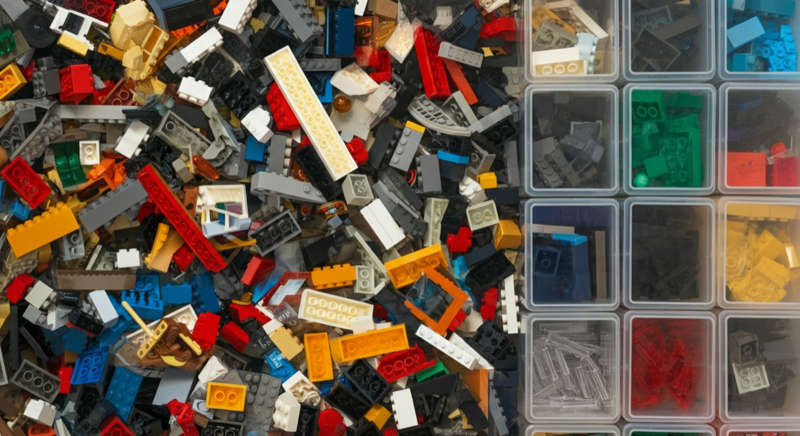
Visually demonstrates the benefit of sorting by contrasting a messy pile with an organized collection.

Why Sorting Matters: The Benefits of Organization


Before diving into sorting methods, let's understand why organization is worth the investment:


  • Building Efficiency: Spend more time building, less time hunting for pieces. A well-organized collection can reduce build times by 50-70%.

  • Creative Freedom: When you can see what pieces you have, inspiration flows more naturally. Discovering forgotten elements sparks new MOC ideas.

  • Prevent Loss: Small, valuable pieces (rare colors, unique prints) won't get lost in bulk piles.

  • Space Optimization: Organized storage uses 40-60% less space than random bins, freeing up room for more LEGO.

  • Resale Value: If you ever sell sets or bulk lots, organized inventory commands premium prices and sells faster.

Beginner Sorting Methods: Getting Started

If you're facing your first bulk pile or reorganizing a small to medium collection (under 10,000 pieces), start with these foundational methods:

Method 1: Sort by Color

Best for: Beginners, kids, collections under 5,000 pieces

Sorting by color is intuitive, visual, and provides immediate gratification. Separate bricks into major color groups:

  • Common colors: Red, Blue, Yellow, Green, Black, White, Gray (Light and Dark)
  • Secondary colors: Orange, Brown, Tan, Purple
  • Special categories: Transparent pieces, metallics, rare colors

Pros: Quick to start, easy to maintain, works well for kids and display-focused collectors

Cons: Inefficient for building (you'll still search through large color piles), not scalable for large collections

Pro Tip: Even if you plan to use advanced methods later, color sorting is an excellent first pass. It breaks down overwhelming piles into manageable categories.

Method 2: Sort by Element Type

Best for: Builders focused on functionality, collections 5,000-15,000 pieces

Sorting by brick type groups pieces by function rather than appearance:

  • Bricks: Standard 2x4, 2x2, 1x4, etc.
  • Plates: Flat pieces (1x2, 2x4, baseplates)
  • Slopes: Angled pieces for roofs, curves
  • Specialty: Hinges, clips, axles, connectors
  • Technic: Beams, pins, gears, axles
  • Decorated: Printed tiles, stickers, unique elements
  • Minifigure Parts: Heads, torsos, legs, accessories

Pros: Highly functional for building, scales well to medium collections, easier to find specific element types

Cons: Requires more initial learning curve, less visually intuitive for beginners

Essential Storage for Beginners

Start with these affordable, accessible storage options:

  • Ziploc Bags (Gallon & Quart): $10-20 for 100+ bags. Perfect for initial sorting, portable, see-through. Buy Ziploc bags
  • Plastic Drawer Units: $15-40 at hardware stores. Sterilite or Iris 3-drawer units work great for 5,000-10,000 pieces. Shop plastic drawers
  • Small Plastic Bins: $1-3 each. Dollar stores sell 6"x6" bins perfect for color-sorted collections. Find storage bins
  • Tackle Boxes: $10-30. Great for small specialty pieces (minifig accessories, rare elements). Browse tackle boxes

Illustrates the 'color + type' hybrid sorting method, making it easier to understand.

Intermediate Techniques: Hybrid Systems


Once your collection exceeds 10,000 pieces or you're building more complex MOCs, hybrid sorting systems offer the best balance of efficiency and accessibility:

Hybrid Method: Color + Type

Best for: Serious builders, collections 15,000-50,000 pieces

Combine color and type sorting for maximum building efficiency:

  1. First-Level Sort: Separate by common colors (Black, White, Light Gray, Dark Gray, Red, Blue, etc.)
  2. Second-Level Sort: Within each color, sort by element type (bricks, plates, slopes, specialty)

Example: Black bricks in one drawer, black plates in another, black slopes in a third.

Pros: Excellent building efficiency, scalable to large collections, intuitive once established

Cons: Requires more storage containers, initial setup takes longer (20-40 hours)

Intermediate Storage Solutions

  • Akro-Mils Drawer Cabinets: $40-150. Industry standard for serious builders. 44-drawer units perfect for hybrid color+type sorting. Shop Akro-Mils organizers
  • Really Useful Boxes: $8-25 each. Stackable, clear, available in 12+ sizes. Great for large element categories. Find Really Useful Boxes
  • Plano Tackle Storage: $15-40. Compartmentalized trays work perfectly for minifig parts and small specialty pieces. Browse Plano storage
  • IKEA TROFAST Bins: $3-8 each. Colorful, stackable, perfect for kid-friendly organization or large-piece storage.

Advanced Systems: Professional-Level Organization

For collections exceeding 50,000 pieces, MOC builders, or those selling parts, advanced cataloging systems maximize efficiency:

Part Number & Element ID System

Best for: Professional builders, collectors 75,000+ pieces, BrickLink sellers

The ultimate organization method uses LEGO's official part numbering system:

  • Design ID: Identifies the brick mold (e.g., 3001 = 2x4 brick)
  • Element ID: Identifies specific color + design (e.g., 300126 = Red 2x4 brick)

Implementation Steps:

  1. Sort by element type (bricks, plates, slopes, etc.)
  2. Within each type, organize by Design ID (use BrickLink's catalog)
  3. Label drawers with part numbers and common names
  4. Use inventory software (Rebrickable, Brickset, BrickStock) to track quantities

Pros: Maximum building efficiency, precise inventory control, facilitates BrickLink selling, universal system

Cons: Steep learning curve (100+ hours initial setup), requires ongoing database management, overkill for casual builders

Advanced Storage: Professional Setup

  • Akro-Mils 64-Drawer Cabinet: $100-200. The ultimate storage solution for 50,000+ pieces. Shop 64-drawer cabinet
  • IRIS 10-Drawer Rolling Cart: $60-100. Mobile storage for active building projects. Find IRIS drawer carts
  • Parts Cabinets (40-60 drawers): $150-400. Professional-grade steel cabinets with transparent drawer fronts.
  • Label Makers: $25-50. Essential for advanced systems. Brother P-Touch or DYMO label makers. Shop label makers

Digital Inventory Management

Advanced builders should leverage these free tools:

  • Rebrickable: Upload your set collection, generate parts inventories, discover alternate builds
  • BrickLink Studio: Free CAD software for MOC design with built-in parts inventory
  • BrickStock: Desktop software for managing BrickLink orders and inventory
  • Brickset: Comprehensive set database with collection tracking

Workflow Tips: Maintaining Your System

Organization is only effective if you maintain it. Follow these workflow practices:

Sorting Station Setup

  • Dedicated Space: Designate a permanent sorting area with good lighting and table space
  • Sorting Trays: Use compartmentalized trays to pre-sort before final storage
  • Music/Podcast: Sorting is meditative—put on your favorite background audio
  • Family Involvement: Make it a fun activity for kids (assign color sorting tasks)

Handling Large Bulk Lots

Purchased a massive unsorted bulk lot? Follow this workflow:

  1. Initial Pass (15 minutes): Remove obvious trash, dust, non-LEGO items
  2. First Sort (2-4 hours): Separate into broad categories (bricks, plates, slopes, minifigs, specialty)
  3. Second Sort (10-20 hours): Within each category, sort by color or part type based on your system
  4. Cataloging (5-10 hours, optional): Log valuable pieces, rare colors, complete minifigs
  5. Final Organization (2-3 hours): Label containers, photograph storage layout, update inventory

Cleaning Used Bricks

Before organizing bulk purchases, clean your LEGO:

  • Washing Machine Method: Place bricks in mesh laundry bags, wash on gentle cycle with cold water and mild detergent
  • Hand Washing: Warm soapy water in a large basin, gentle scrub with soft brush
  • Drying: Air dry on towels for 24-48 hours. Never use hot water on transparent pieces (causes clouding)
  • Sticker Removal: Use Goo Gone or rubbing alcohol for stubborn stickers (test on hidden area first)

Storage Solutions Comparison Table

Storage Type Price Range Best For Capacity Pros Cons
Ziploc Bags $10-20/100 Beginners 500-1,000 pieces/bag Cheap, portable, see-through Not stackable, tears easily
Plastic Drawer Units $15-40 Small-medium collections 5,000-10,000 pieces Affordable, accessible Limited drawer sizes
Akro-Mils 44-Drawer $80-150 Serious builders 30,000-50,000 pieces Modular, professional-grade Expensive upfront
IRIS 10-Drawer Cart $60-100 Active projects 15,000-20,000 pieces Mobile, large drawers Takes up floor space
Really Useful Boxes $8-25 each Large elements Varies (4L-84L) Stackable, clear, durable Requires shelving space
Tackle Boxes $10-30 Small specialty pieces 500-2,000 small pieces Compartmentalized, portable Limited scalability

Common Mistakes to Avoid

  • Over-Sorting Too Soon: Don't jump to advanced part numbering with a 5,000-piece collection. Start simple, scale up as needed.
  • Cardboard Boxes: Avoid long-term storage in cardboard—attracts moisture, pests, and degrades over time.
  • Opaque Containers: Choose clear storage whenever possible. "Out of sight, out of mind" means pieces won't get used.
  • No Labeling System: Label everything. Memory fades, and unlabeled drawers become chaos within months.
  • Incomplete Projects: Don't start a new sorting system without finishing your current method. Transition gradually.
  • Ignoring Minifigs: Minifigures deserve special organization—keep complete figures together, separate loose parts systematically.

Conclusion: Start Small, Scale Smart

The perfect LEGO organization system is the one you'll actually maintain. Start with beginner methods (color or type sorting), invest in affordable storage, and scale up as your collection grows. Remember:

  • Collections under 5,000 pieces: Color sorting + plastic bins
  • Collections 5,000-15,000 pieces: Type sorting + drawer units
  • Collections 15,000-50,000 pieces: Hybrid color+type + Akro-Mils cabinets
  • Collections 50,000+ pieces: Part numbering + digital inventory + professional storage

Most importantly, make organization enjoyable. Put on music, involve family, celebrate milestones (first 10 drawers organized, reaching 50% sorted, etc.). An organized collection isn't just functional—it reignites creativity and makes every building session more enjoyable.

Ready to upgrade your storage? Browse our curated collection of LEGO storage solutions on Amazon or explore our LEGO display guide for showcasing your builds.