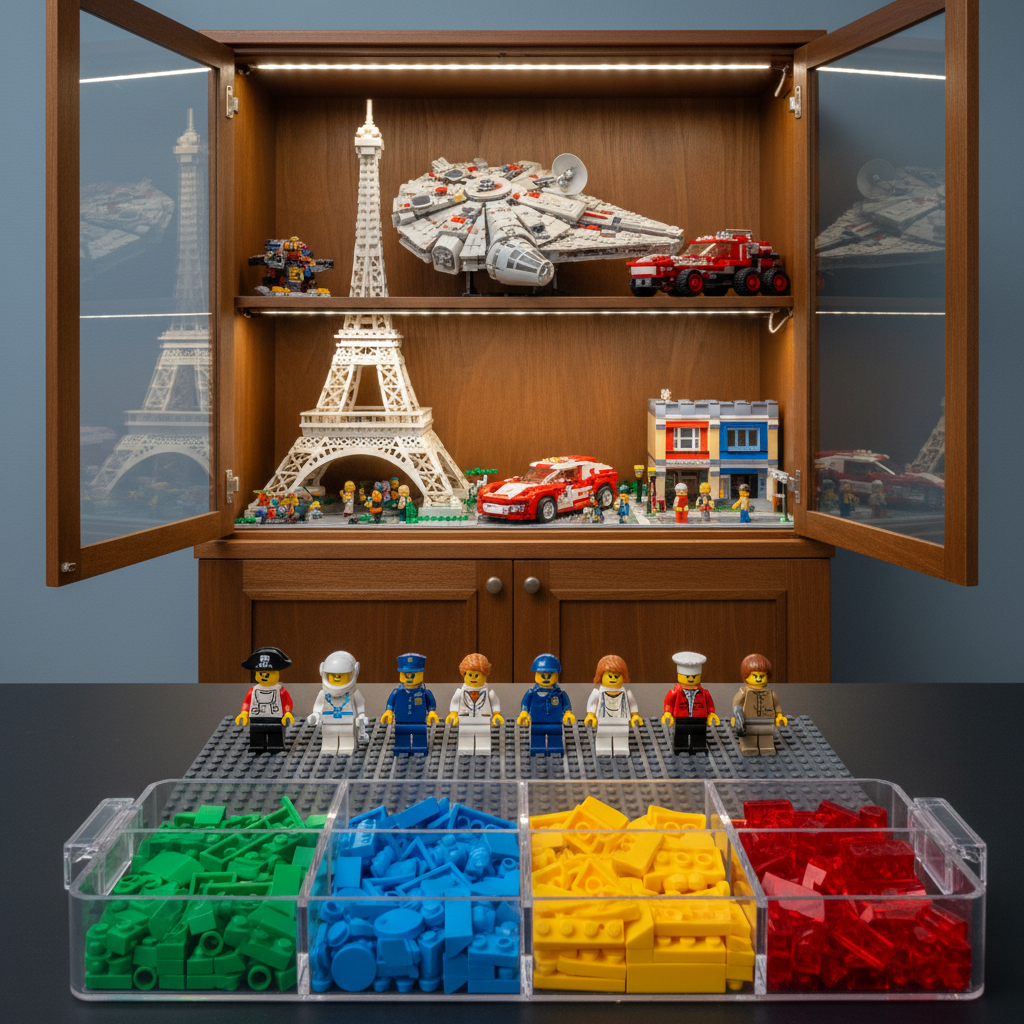
A large LEGO collection needs three systems: one for loose parts you build with, one for finished sets on display, and one for sets kept together to rebuild or sell. Parts work best sorted by type into drawer cabinets, displayed sets belong behind glass and out of the sun, and kept sets belong in labelled bags. Add an inventory and you can see what you own before you buy more.
Quick answer: parts by type in drawer cabinets, displayed sets in glass-door cabinets or acrylic cases away from direct sun, kept sets bagged and labelled with their set number, everything in a dry indoor room away from heat, and an inventory you can search.
Loose parts: sort by type, then by color
For building, sort by part type first: bricks, plates, tiles, slopes, Technic beams and pins, wheels, and so on. You usually know the shape you need before the color, so type sorting finds parts faster. Once a part family outgrows its container, split it by color. Color-first sorting suits mosaic and LEGO Art builders.
Small parts are where most of the searching happens, so give them drawers. A small-parts drawer cabinet of the kind sold for workshops holds one part family per drawer and stacks on a shelf or desk: small-parts drawer cabinets on Amazon. Larger parts and bulk go in deeper lidded bins. Label every drawer and bin with the part name or a picture, so the system works for anyone who builds with you.
Our Sorting Planner suggests how to split the parts from a list of sets into the number of bins you have and prints labels. For the trade-offs between methods, see sorting by color or by part type.
Built sets: behind glass, out of the sun
Dust settles into every gap of a built model, and direct sunlight yellows and fades bricks over time, white and light gray first. A closed cabinet solves both. IKEA's BLÅLIDEN glass-door cabinet is 13¾ by 12⅝ by 59½ inches (wide, deep, high) with three adjustable glass shelves IKEA rates at 7 pounds each, and IKEA says to anchor it to the wall. For a whole display, a wider cabinet or a bookcase with glass doors holds more; check the depth against your largest model before you buy. Our IKEA display guide lists sizes and load ratings.
A single large model, such as a starship or a big landmark, is better in its own clear acrylic case. Measure the model first, and allow space around it: acrylic display cases on Amazon. For lighting, placement and shelf depth, see How to Display Your LEGO Collection.
Sets you may rebuild or sell
If you take sets apart to save space, keep each one in its own bag or box labelled with the set number, with its instruction booklet and any sticker sheet. Store sealed boxes so that nothing heavy crushes them. A set kept together this way rebuilds in an evening and sells as complete. Before you sell or rebuild, our Missing Piece Checker shows what is missing and gives element IDs for replacements.
Where to keep it all
Keep the collection indoors in a dry room that stays at a normal living temperature. LEGO warns that heat can warp bricks, so avoid hot attics, sunny windowsills and garages, and keep cardboard boxes out of damp basements. Closed boxes and cabinets keep out dust and stray light.
Keep an inventory
Once a collection is large, an inventory saves money: you can check what you already own before buying a set or a part. Record each set by its number and note whether it is sealed, built or bagged. For tools that do this, see digital inventory tools for your LEGO collection.
Cleaning
When pieces need washing, follow LEGO's own advice: by hand, in water no hotter than 40°C (104°F), with a mild detergent if needed, rinsed in clear water and left to air dry out of direct sunlight. Never use a washing machine, dishwasher, oven, microwave or hair dryer. For dust on built models, see Protecting LEGO From Dust.
Related guides